
Most people who look into cosmetic dentistry have something specific they’d like to change. Examples include a chipped front tooth, teeth that have yellowed over the years, or a gap that shows in photos. Whatever you want to fix, choosing the right cosmetic dentist matters as much or more to your final result than the treatment itself.
The results of your cosmetic work are visible every day, and a lot of it is permanent. It’s worth comparing a few offices before you commit. This guide covers what to check, what to ask, and how we approach cosmetic care for patients in Crownsville, Gambrills, Annapolis, Davidsonville, and across Anne Arundel County.
What a Cosmetic Dentist Does
“Cosmetic dentistry” is not an ADA-recognized dental specialty. Any licensed general dentist can call themselves a cosmetic dentist and offer whitening, bonding, or veneers. The difference between offices comes down to training, case experience, and how much attention goes into design.
Color is only a small part of the design. A cosmetic dentist should also consider tooth shape and length, how the teeth line up with your lips, and how much gum shows when you smile. The goal is a result that fits your face and looks natural, not obviously restored.
Common treatments include professional teeth whitening, porcelain and no-prep veneers, composite bonding, gum recontouring, and clear aligner therapy with Invisalign®. Some patients need only one of these. Others get a better outcome from a well-planned combination.
What to Look for When Choosing a Cosmetic Dentist
First, make sure the provider is a licensed dentist. Every dentist practicing in Maryland must hold an active license, which you can confirm through the Maryland State Board of Dental Examiners. The ADA has cautioned the public about unlicensed “veneer techs” who advertise on social media. The problems they cause, including nerve damage and infection, can be difficult to reverse.
Once licensing is confirmed, here are some points to compare offices:
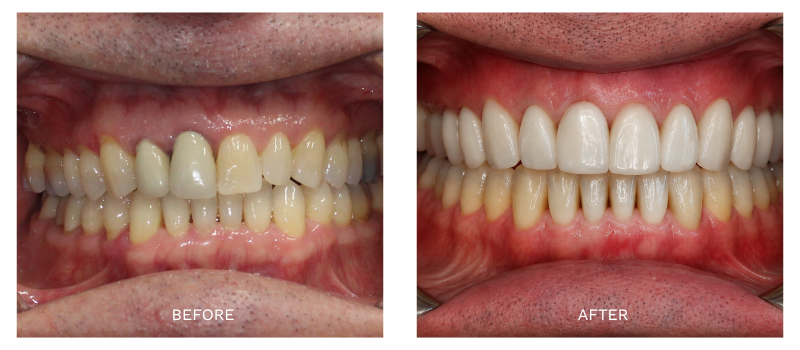
- Before-and-after photos of the dentist’s own patients. We proudly show our results in our smile gallery.
- Continuing education. Materials and techniques change often. Membership in a group such as the American Academy of Cosmetic Dentistry indicates a dentist who keeps training.
- A health-first approach. Veneers placed over decay or gum disease fail early. A thorough exam should come before any cosmetic plan.
- Current technology. Digital scanning and in-office fabrication usually mean a more precise fit and fewer visits.
- Patient reviews. Read how people describe the experience, not only the result.
- Conservative treatment options. The best plan removes as little natural tooth structure as possible. If a dentist recommends heavy drilling without discussing alternatives, that’s a reason to get a second opinion.
Questions to Ask at Your Consultation
A consultation works in both directions. The dentist evaluates your teeth, and you evaluate the dentist. Bring a short list of questions.
- How many cases like mine have you completed?
- Can I preview the result before anything permanent is done?
- Will my natural teeth need to be reduced, and by how much?
- Would straightening my teeth first improve the outcome?
- How long should the treatment last, and what maintenance does it need?
- What is the total cost, and is financing available?
Notice how the visit goes. Did the dentist ask what you want, or only tell you what you need? Did you have time to ask questions? You should leave understanding your options and the reasoning behind the recommendation.
Cosmetic Dentistry at Crownsville Dental & Wellness Solutions
Dr. Eric Rabovsky plans every cosmetic case around one priority: preserving as much natural tooth as possible. A good-looking result that costs you healthy enamel is not a good trade, and most of the cosmetic dentistry we offer is built on that principle.
Many patients arrive asking about veneers and leave with a different plan. Crowded or rotated teeth often force a dentist to grind more enamel to fit veneers. A short course of Invisalign® first can allow minimal-prep or no-prep veneers instead. Dr. Rabovsky explains the reasoning in this post on straight teeth and veneers.
Before any veneer is bonded, we make a trial smile. It’s a temporary mock-up placed on your own teeth so you can check the shape and shade and request changes.
We also produce veneers and restorations in our office with dental 3D printing. Avoiding an outside lab gives us a more precise fit, a shorter wait, and more predictable pricing. Our post on what veneers cost explains the factors that affect price, and CareCredit financing is available.
Veneers are not the answer for every smile. We also provide professional teeth whitening, composite bonding, tooth and gum recontouring, and crown lengthening for gummy smiles. The ADA’s MouthHealthy page on veneers is a good neutral overview of the options.
A Cosmetic Dentist Near You in Anne Arundel County
Our office is on Generals Highway in Crownsville, a short drive from Gambrills, Annapolis, Davidsonville, and the rest of Anne Arundel County. Patients come to us from across the county for cosmetic care.
Choosing the right cosmetic dentist is important, so we encourage you to compare your options. When you’re ready to discuss your goals, call us at 410.923.0110 or request a consultation online.